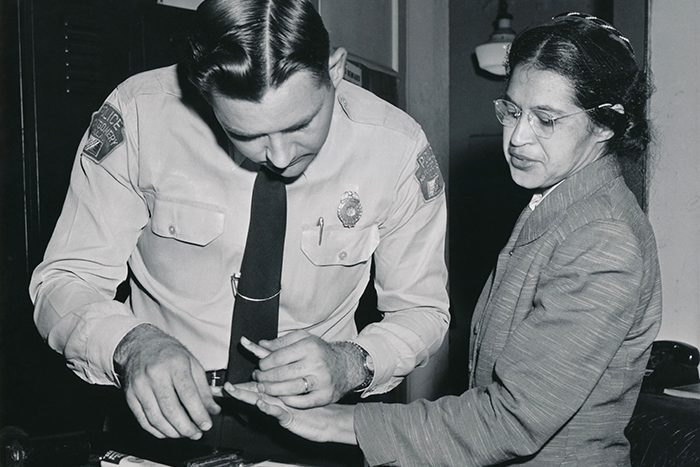
Parks being fingerprinted by Lieutenant D.H. Lackey on February 22, 1956, when she was arrested again, along with 73 other people, after a grand jury indicted 113 African Americans for organizing the Montgomery bus boycott.
The city seal of Montgomery, Alabama says it all. On its top is the motto: "Cradle of the Confederacy," and at its base the motto: "Birthplace of Civil Rights." Two mottos in absolute conflict with one another. One holding fast to the "Lost Cause." One marking the long arc of justice-albeit incomplete.
A statue of Jefferson Davis, the president of the Confederacy, still sits atop the capitol steps in Montgomery, as does a bronze star in the shape of the Magen David, marking the spot of his inauguration. Around the left side of the capitol building stands a monument, designed in 1865 and dedicated to Alabama's 122,000 soldiers enlisted in the armed forces of the Confederacy. The monument stands 88 feet high, casting a long shadow on the capitol grounds and the State of Alabama.
Ninety years later, on December 1, 1955, Rosa L. Parks, in defiance of Jim Crow laws, refused to give up her seat to a white person. She was arrested. Shortly after her arrest, the 385 day Montgomery bus boycott began. The determination of the Black citizens of Montgomery to protest racial segregation on public transportation, was the catalyst for the civil rights era of the 1950's and 1960's and must be honored here in Alabama and across the country.
This year, we mark the 70th commemoration of the Montgomery bus boycott, which falls on Monday, December 1 - Fourscore and ten, a lifetime away. Mrs. Park's courageous act of civil disobedience was rooted in the Jewish values of justice: Tzedek, tzedek tirdof (Justice, justice, you shall pursue), a call for the active and determined pursuit of justice, and tikkun olam (repairing the world), the Jewish ideal of each person participating in the repair of a broken world, in which imbalance and disregard still exist.
The Southern Youth Leadership Development Institute is leading a series of commemoration events for the 70th anniversary. My own congregation, Temple Beth Or in Montgomery, is proud to support the commemoration. We invite synagogues across the country to join us in commemorating and rededicating ourselves to civil rights:
- Mention the 70th anniversary in a Shabbat sermon on December 5th.
- Light an extra Shabbat candle that evening, adding light to the world - as memorial and present guidance.
- Send out a congregation- wide note on December 1st.
- Incorporate the 70th anniversary in the lessons of religious school students on Sunday, December 7th, in art or in story (tying it to the story of the Exodus; people marching on foot to a promised place of safety and justice).
- Sound the shofar - a clarion call to remind us of that then historical moment.
The 1955 Montgomery bus boycott is said to have birthed the Civil Rights Movement. Let our voices not be silent in this moment of challenge. May we, in one manner or another, continue to walk alongside our fellow citizens, determined not to stop marching until all in our nation have reached a sacred destination, a place in which the divine dwells in the light of our deeds and in our hearts.
Related Posts
Reflections on a Special Martin Luther King, Jr. Day
Three Supreme Court Cases You Should Know About